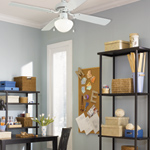
Today ceiling fans are an important part of creating the perfect home decor. For those hot,
humid days of summer, there’s nothing more wonderful than a cool breeze. Fans have become more technologically advanced,
providing cooling in the summer months and warming in the winter months to drastically save on your energy bill up to
40% in the summer and 10% in the winter, using only as much as energy as a 100 watt light bulb. Fans are used in the
main rooms in your home, patios, verandas, kitchens and bathrooms; anywhere dampness may be an issue.Ceiling fans can provide years of comfort and beauty. Select a fan that coordinates
your individual home style by choosing the color, finish, blade design, size, accessories, lighting and style.
There are many styles to choose from, including polished brass, antique brass, iron, copper, nickel, pewter,
chrome, black, vibrant colors, oak, rosewood and other real wood veneers. There are candelabra fans available
and many fans are accessorized by matching pendants, lamps and sconces.
What size ceiling fan do you need?
For maximum comfort and air efficiency the size of the fan should be determined based on the size of the room.
??42" – 50" fans
medium rooms – 15' x 15' for rooms up to 225sq ft
52" – 60" fans large rooms – 10' x 25' for for rooms up to 500sq ft
Ceiling Fan Placement
Place the fan higher than 7ft. above the floor in the middle of the room for maximum comfort,
circulation, safety and aesthetics. Optimal placement would be either 8 or 9ft. from the floor.
Ceiling Fan Blades
Fan blades determine the amount of air being circulated throughout the room.
The blade pitch is also important, as this along with the blade span is what determines the degree the fan
will cool the room. The steeper the pitch, the more effective the fan will be in moving the air so look for
blade pitches that are between 11°and 16° and be weighed and matched as a balanced set to avoid having your
fan wobble. The greater the angle of the blade the more air circulation you will have in your room. Blades
should be made with wood or acrylic and be sealed and treated to resist humidity.Finish makes the fan blades more durable. A high quality finish will resist
against blistering, tarnishing, fading and corrosion. Less advanced finishes on the fan blades can be very
fragile and start to peel, bubble and corrode quickly. Brass finishes are long lasting, scratch resistant
and never need polishing. Painted finishes are thick, rich and durable as a result of the advanced painting
process. Wood blades are still a popular choice; just make sure they are properly sealed to avoid warping.
This would be especially important if you plan to install the fan in a room such as a bathroom or kitchen, or
outdoors. In addition to wood blades, you will find some that are a paddle design, tropical leaf design, white,
just about every design you can think of.
Ceiling Fan Motors
The heart of every ceiling fan is the motor. You will find that they range
from 1/60 and 1/3 horsepower. Motors that are higher powered will help produce more air. Additionally,
the higher-powered motor will not overheat like fans that have lower powered motors. The motor is responsible
for producing quiet operation while driving the blades for air movement. Look for high-quality motors with
heavy-duty windings and sealed bearings which never need to be oiled. Another good option is a rubber flywheel,
which helps keep torque under control. This helps to stabilize the fan while keeping the level of noise down.
Smaller, less powerful motors found on lower quality fans may produce higher operating temperatures, lower air
circulation and noisier operation. Motors are designed to work flawlessly and should have a long lasting life.
Ceiling Fan Light
OptionsYou do not need to have a light with your fan but it does add the finishing
touch. You can choose from classic to contemporary lights to complement your home decor. Opal, marble, crystal, glass
and hand blown glass can also be added to a fitter or fixture shade to enhance the design. Light kits can also be
added. Uplighting is also available; the light bounces off the ceiling to create more of a mood effect than the
traditional downlighting for a more relaxed atmosphere.
Ceiling Fan Types
You can choose to have the fan mounted flush to the ceiling or hung down from a pole.
There are systems available that allow a flush-to-ceiling mounting so there is extra clearance, a standard type of
hanging using a downrod, or for vaulted ceilings, an angled mounting. The last option can accommodate pitches as great
as 34°. When additional clearance is needed, such as a very low ceiling height or that you are very tall, a
ceiling hugger fan designed to make sure there is maximum clearance without giving up any air movement. Additionally,
for those extra high ceilings, there are extension downrods, which work best with blades from 7 to 8ft. If you have a
ceiling that measures 9ft. or more, the extension downrod will help position the fan so it is at the appropriate height
to the floor. As an example, if you have a 12ft. ceiling, the extension downroad would need to be 3ft. This would
position the fan to 8ft. from the floor and allow 1ft. for the fan itself for a total of 12ft.
Ceiling Fan Speeds and Controls
The standard ceiling fan has three speeds or four speeds. And reversible speed
indicates that during the winter months, you can reverse the direction of your blades to help push the warmer
air captured by the ceiling down into the room. To make this change, you simply switch the reverse switch. For
ceiling fans with a wall control, you can easily adjust your speeds anyway you like..
Remote controls have gained popularity, so instead of pulling the chain to change the speed,
you can use your remote control without ever climbing out of bed or getting up from the couch. It is almost a requirement
these days is a remote control system which allows a user to turn the fan on and off, adjust the speed, and control the
fan's operations remotely. This can be done either from a wall unit or from a remote controlled hand-held unit. The
remote unit can also have a large number of speed adjustment options as well. This is particularly helpful to adjust
the circulation provided by the ceiling fan.
Ceiling Fan Installation and Usage Tips
Ceiling fan performance and energy savings rely heavily on the
proper installation and use of the ceiling fan. Here are a few tips to ensure quality and product performance.
Choosing the appropriate UL-rated electrical box>
Make sure that you use the appropriate UL-listed metal box, marked "For Use
with Ceiling Fans." This outlet box is mounted above the ceiling and also is the point where the fan is attached.
This box houses all wiring needed to operate and connect the ceiling fan. If you are replacing a ceiling fixture, most
likely you will need to replace the electrical box.
Mounting the ceiling fan
If possible, the ceiling fan should be anchored to a ceiling joist. In the case that the
joist is not located in the center of the room, a special ceiling fan mounting bracket with spiked ends should be installed
between joists. Keep in mind that ceiling fans can weigh as much as 50lbs.! For tips on installing a ceiling fan, click
on the file below.
Balancing a wobbly fan
All fan blades should be balanced prior to shipment; however, if the fan is wobbly
after installation, there are ways to fix it. First, make sure that all connections are properly aligned and tightly
fastened. Check the alignment of the blades by holding a yardstick vertically along the edges; you may be able to
gently bend a misaligned blade holder back into proper place. If all blades are aligned, a balancing kit can then
be used to pinpoint the culprit.
Turn off when out of the room
Ceiling fans cool people, not rooms. If the room is unoccupied, turn off the
ceiling fan to save energy.
Use the ceiling fan year round
In the summer, use the ceiling fan in the counter-clockwise direction. The
airflow produced by the ceiling fan creates a wind-chill effect, making you "feel" cooler. In the
winter, reverse the motor and operate the ceiling fan at low speed in the clockwise direction. This produces
a gentle updraft, which forces warm air near the ceiling down into the occupied space. Remember to adjust your
thermostat when using your ceiling fan - additional energy and dollar savings could be realized with this simple step!